

How To Get Cited In AI Search
How to Get Cited in AI Search starts with a simple truth. AI tools cite content they can find, understand, and trust. If your website is thin, slow, vague, or full of recycled fluff, do not act surprised when it gets ignored. UK businesses need clear pages, real proof, strong structure, and useful answers. Start with a solid digital base from Cleartwo, then build content that deserves to be cited.
Why AI Citations Matter
AI citations matter because they place your business inside the answer. Not buried under ten blue links. A citation is when an AI search result links to your page as a source. A mention is when your name appears with no link. A recommendation is when the system suggests your business as an option. Nice, but not the same thing. Let's not pretend they all carry equal value.

Cleartwo helps UK businesses build the content, technical base, and tracking process needed for AI search visibility. That includes the dull but vital work that keeps pages crawlable, trusted, and useful for real people. Yes, some of it sounds boring. So does bookkeeping, but try running a business without it.
What AI Search Citations Are
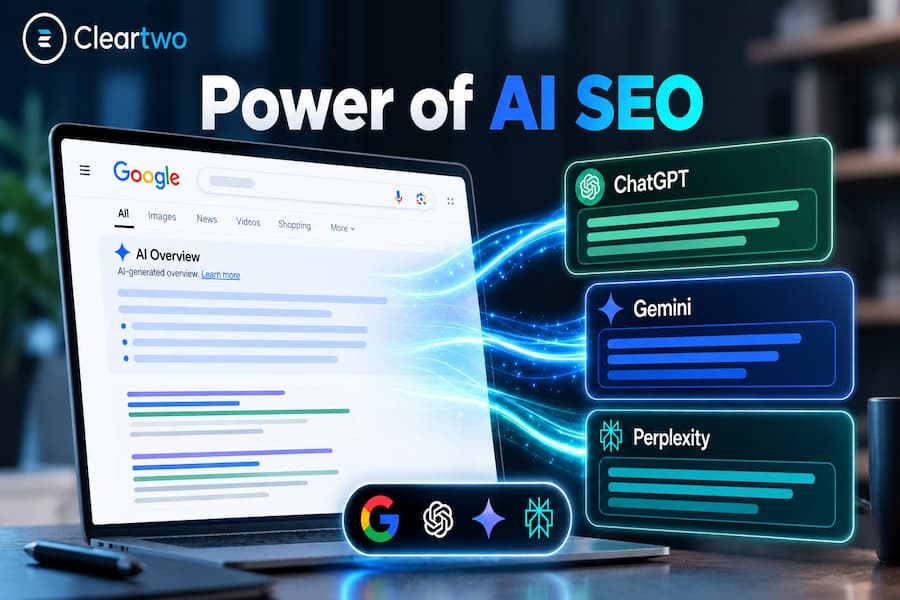
An AI search citation is a linked source used to support an answer from platforms such as Google AI Overviews, Microsoft Copilot, Perplexity, Gemini, and other answer engines. It is not the same as ranking first in traditional search. It is also not the same as being name dropped in a sentence.
AI search tools often use several sources for one answer. Your page may be cited for one section, one fact, or one clear explanation. That means a well written paragraph on a specific topic can earn visibility, even when the full page is not the top organic result.
How AI Search Engines Choose Sources
AI search engines choose sources by matching the user's question with content that is relevant, easy to access, trusted, and useful. It is not magic. It is search, retrieval, review, and answer creation with a shiny layer on top. Nobody is using a crystal ball in a server room.
First, the system works out intent. Is the user asking for a definition, a comparison, a local provider, a product, or a decision guide? Then it may explore related searches. Google calls this query fan out. That means the system checks linked subtopics before forming the final answer.
For example, a UK SME asking about cloud CRM may trigger checks around pricing, data protection, integrations, support, and business automation. A local service search in Manchester, Birmingham, or Leeds may trigger reviews, service areas, and proof of experience. If your content only answers the headline question, you leave gaps big enough to park a lorry in.
Google says standard SEO best practice still applies to AI features. There is no special technical trick for AI Overviews or AI Mode. You can read the official Google Search Central guidance on AI features if you enjoy documents that politely say, stop chasing shortcuts.
Why Traditional SEO Still Matters
Traditional SEO still matters because AI search systems need content they can discover and understand before they can cite it. If your page is blocked from crawling, hidden behind poor internal links, or written like a dusty brochure, you are giving the system very little to use.
Indexation is essential. Search engines must be able to access the page, read the text, and understand the topic. That means clean site structure, sensible internal links, fast pages, mobile usability, and clear headings. Revolutionary, obviously, yet still ignored by far too many websites.
This is where SEO services for stronger search visibility still matter. AI search visibility is not replacing SEO. It is raising the standard for what good SEO needs to deliver.
Authority And Expertise Build Trust
Authority and expertise matter because AI systems are more likely to cite content that looks reliable, clear, and backed by evidence. If your page says you are experts twelve times but proves nothing, that is not expertise. That is theatre.
UK businesses should show real experience. Add clear company details, update dates, case studies, original insights, and examples from actual work. If you serve regulated sectors such as finance, healthcare, legal services, or data led industries, support claims with official sources and careful wording. Do not wing it with money, health, legal, or data protection advice unless you enjoy problems.
E E A T stands for experience, expertise, authoritativeness, and trust. It is not a secret ranking button. It is a useful way to judge whether content looks credible to people and search systems. If the facts are weak and the page only exists to chase traffic, trust will be thin.
How Structured Content Helps Citations
Structured content helps citations because it makes each idea easier to find, understand, and quote. AI systems work better with clear headings, short sections, useful examples, and reliable sources. People like that too. Funny how that works.
Put the direct answer near the top of each key section. Then explain the detail underneath. Do not hide the useful part after six paragraphs of brand waffle. Nobody asked for your company origin story when they wanted a direct answer.
Use headings that match real questions. Keep each section focused on one clear point. Use lists when they help. Do not add lists just because someone said they are good for AI. The goal is clarity, not decoration.
- Clear page purpose
- Direct early answer
- Specific UK context
- Real business proof
- Reliable source links
- Updated factual claims
- Strong internal links
Structured Data And Schema Markup
Structured data helps search systems understand your page. It does not guarantee AI citations. There is no magic AI schema that makes Google worship your website. Anyone selling that as a certainty is selling smoke in a fancy box.
Useful Schema.org types include Organisation, LocalBusiness, Person, Article, BlogPosting, BreadcrumbList, Product, Service, and FAQPage where suitable. The key point is simple. Schema must match the visible content on the page. If it does not, you are not optimising. You are misleading.
For UK businesses, structured data should support real business details. Use consistent company names, addresses, phone numbers, service areas, page topics, and dates. This helps search systems connect your brand with what you do.
Brand Mentions And Digital PR
Brand mentions and digital PR matter because AI search systems build context from the wider web, not only your own site. If trusted sources talk about your brand in the right context, your business becomes easier to recognise. If nobody mentions you anywhere, that is not a great sign, is it?
Good mentions come from relevant publications, industry bodies, local news, events, research, and useful commentary. Bad mentions come from weak directories, spam posts, and articles that only exist to drop a link. Skip the nonsense. Relevance beats volume.
For e commerce marketing, this may mean publishing original shopping data, customer behaviour trends, or expert product advice. For IT support, it could mean advice on SME security, remote working risks, or Microsoft 365 governance. For custom CRM systems, it could mean practical workflow examples and clear results.
Content AI Search Can Verify
AI search is more likely to cite content that makes clear and checkable claims. Saying many businesses struggle with growth is vague. Saying what you observed, how you measured it, and what action helped is useful. See the difference? Good.
Use clear dates, sources, examples, and methods. If you publish data, explain where it came from and what its limits are. If you share advice, show the reasoning. If you update a page, include a reviewed date so readers know it has not been left to rot in a forgotten archive.
Cleartwo also explains these ideas in this guide on measuring AI search visibility. It is useful if you want to stop guessing and start tracking. Because no, vibes are not a reporting method.
How Cleartwo Builds Citation Focused Content
Cleartwo helps businesses improve citation potential by combining strategy, content, technical SEO, and monitoring. No honest team can guarantee an AI citation. Platforms change by query, user, location, model, and timing. Anyone promising guaranteed placement is either confused or hoping you are.
The process starts with prompt research. Cleartwo identifies the questions your customers are likely to ask across Google AI Overviews, Copilot, chat based search, and other answer engines. Then those prompts are mapped against your current pages, content gaps, search intent, and customer needs.
Next comes the content and technical work. This can include better page structure, stronger trust signals, improved internal links, reviewed schema, refreshed facts, and clearer service pages. For some businesses, it also connects with AI marketing tools, business automation, cloud CRM, and wider digital transformation.
Where needed, Cleartwo can support this through AI agency services for UK businesses. The aim is not to chase hacks. The aim is to make your website a stronger source when AI systems decide which pages deserve attention.
How To Monitor AI Search Citations
You monitor AI search citation opportunities by testing a fixed set of prompts and tracking which brands and pages appear. Do this monthly. Do it the same way each time. Do not test one random prompt on a Friday afternoon and call it a strategy.
Build a list of twenty to fifty prompts. Include commercial questions, comparison questions, local questions, information questions, and brand questions. Record the platform, date, location, exact prompt, cited domains, cited pages, brand mentions, tone, and answer accuracy.
Then group the losses. Did another business win because it had better content? Stronger authority? More useful data? Better technical health? Once you know why you are missing, you can fix the right problem instead of throwing another generic article at the wall.
A Simple 90 Day Plan
A 90 day plan gives UK businesses a practical way to improve AI search visibility. There is no secret switch. Start with the basics. Improve content quality. Then build authority. Boring? A bit. Effective? Yes.
Days 1 To 30: Set The Baseline
Audit your website for crawlability, indexation, speed, mobile usability, internal links, and structured data. Check whether key pages answer real questions clearly. Test priority prompts across AI search platforms and record who gets cited.
Days 31 To 60: Improve Key Pages
Improve your strongest pages first. Add direct answers, UK context, better evidence, clear business details, and supporting articles around related questions. This is where answer engine optimisation and generative engine optimisation meet proper content strategy. Not keyword confetti.
Days 61 To 90: Build Authority And Measure
Promote original insights through relevant channels. Look for digital PR opportunities, partnerships, expert comments, and useful industry resources. Retest your prompt set. Then connect changes to traffic, enquiries, branded search, and conversions.
Common Mistakes That Stop AI Citations
The biggest mistake is treating AI search like a shortcut. It is not. Thin content, weak sources, poor structure, and vague claims still fail. Slapping AI optimised onto a page does not make it useful. It makes it look like you attended one webinar and got carried away.
Another mistake is ignoring technical health. If your site is slow, broken, messy, or hard to crawl, citation chances drop. The same applies when brand details are inconsistent across the web. Search systems need confidence, not a scavenger hunt.
Final Thoughts
AI search feels messy because it changes fast. Panic will not help. A clear review will. Audit what gets cited now. Fix content and technical gaps. Build proof that search systems can trust. If you want a clearer route through the noise, speak to Cleartwo and start with a proper visibility review.
Frequently Asked Questions
Can Any Business Guarantee An AI Search Citation?
No. AI search platforms change often. Citations depend on the query, source set, location, timing, and user context. You can improve your chances, but you cannot force selection.
Does Schema Markup Guarantee AI Citations?
No. Schema helps search systems understand content, but it does not guarantee a citation. It should support accurate visible content. It cannot replace good writing and real expertise.
Is Ranking First On Google Enough?
No. Strong rankings help, but AI search may cite pages that answer related questions better. A lower ranking page can still be useful for one part of an AI answer.
How Often Should UK Businesses Test AI Search Results?
Monthly testing is a sensible starting point. Test the same prompts each time. This helps you compare changes properly instead of chasing random results.
What Should I Fix First?
Fix crawlability, weak content, poor structure, unclear trust signals, and outdated claims first. Then build authority through useful content, brand mentions, and consistent measurement.