

What does the future hold for IT support in education? This question is top of mind for many school IT managers, university administrators and education policymakers across the UK. As digital learning becomes the norm, IT teams need to keep pace with evolving technologies, mounting demands and tighter budgets.
In 2026 downtime at schools and universities will cost millions of teaching hours and administrative delays ultimately. That alone is a testament to how critical effective IT support has become. So, what trends should the schools watch? What will be the challenges? And more importantly, what are the opportunities to be grasped to build robust IT foundations for the future?
The whole issue is, the situation is rather complex, but it doesn’t mean you have to navigate it by yourself. This is where cleartwo’s IT support services comelarin.pub. They’re designed specifically to help UK education providers manage their tech smoothly–keeping everything running and ready for what’s next.

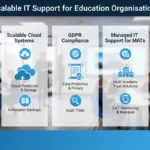
An image showing a dedicated IT support team managing digital tools in a school setting.
Key Trends Shaping IT Support in Education
The education sector’s IT support isn’t just about fixing broken computers anymore. It’s expanding to include sophisticated tools and new approaches that transform teaching and learning. Let me break this down:
- AI moving from novelty to necessity: Artificial Intelligence plays a growing role in automating system monitoring, detecting cyber threats, and personalising student learning experiences. Schools can harness AI for routine tasks, freeing up staff to focus on bigger priorities. But it’s crucial to manage it carefully given the data privacy concerns. You might want to check out some insights on AI adoption in education.
- Cloud beyond migration: Moving systems to the cloud is more than an upgrade; it is the agility and scale unlocked. Cloud platforms enable hybrid learning models and seamless resource sharing between campuses. IT support teams now need skills in managing cloud security and cost optimisation–both for keeping outreach and promoting collaboration between units.
- Hybrid learning ecosystems: Supporting a mix of in-person and remote teaching means networks and devices must be reliable and secure anywhere. IT teams build flexible infrastructures and tools tailored for personalised learning paths, accommodating different student needs.
Thus, they are the ones IT support teams go beyond being just a back-office function to become the strategic partners in education. What about your team? What are you doing to keep abreast?
Facing the Challenges in UK Education IT Support
At the field level, UK schools and universities have to struggle with some hard facts. Certainly, I can tell keeping up with technology can sometimes seem so overwhelming. Below are some of the common ones:
- Skills gaps and resource shortages: The lack of education-focused IT specialists is a challenge. Attracting and keeping the right talent is difficult, so training and partnerships are key.
- Legacy infrastructure holds back progress: Many schools are stuck with outdated networks or systems that can’t meet modern demands, causing frustrating downtime.
- Rising cyber threats: Education is a prime target for cyber attacks, ranging from phishing to ransomware. IT teams need to constantly update defenses to protect confidential information and hold on to trust.
This way, continual system checks, along with the modernising game plan, would be fundamental. The good news is, the school system auditing service is the framework
Emerging Opportunities and Practical Steps
Honestly speaking, the future is plentiful regarding the opportunities to be ahead of the challenges. You’re walking with tight budgets and high expectations. Does it sound familiar? With the focus on smart IT support, you will be able to make your school or university more efficient and improve learning environments at the same time.
Some prominent actions worth initiating are:
- DfE digital standards compliance by 2030: Getting it right first time by planning early for these requirements will surely reduce stress. Integration of standards into the routine IT support would make compliance easy.
- Forming strategic partnerships: Outsourcing certain tasks to managed IT providers gives access to specialised skills and 24/7 support without blowing your budget.
- Five-step ICT audit checklist: Regularly review your hardware, software, training needs, security posture and network performance to spot issues before they cause disruption.
- Partner vetting framework: Evaluate potential IT suppliers based on education sector expertise, scalability and proactive support services.
- AI policy template: Develop clear guidelines for ethical and secure AI use in classrooms and operations to mitigate risks.
By crossing these items off, you’ll be incrementally ensuring the survival of your tech in a practical and manageable way.
How to Future-Proof Your IT Support Strategy
The long-term success boils down to the right partnerships and the wise investment in training. Let me clarify:
- Vendor selection criteria: Source for IT support that truly understands the challenges of education sector, offers flexible packages and can grow with your needs.
- Clear training roadmaps: Building internal skills remains crucial. Upskill your team in cloud tech, cybersecurity and AI awareness.
- Use metrics to measure success: Track uptime, response times, user satisfaction and security incidents to keep improving support quality.
With these pieces fixed, your institution will not only survive change but will assure its propelling.
To make it even real, we have worked with a college in Manchester which had a problem with frequent outages and just clouded IT responsibilities. After they accustomed themselves to a quite simple IT support scheme with regular audits and users training, they managed to cut the downtime by 40% in the first six months. The staff felt in control, and the students perceived a quicker help. The moral of the story is: It is not about the fancy tech but a system that works and people who know how to use it.
If you’re interested in how to enhance your IT support, you can check out cleartwo’s education IT support solutions. They include everything from routine maintenance to advanced infrastructure upgrades tailored for UK schools and universities.
Quick Reference: Key Points to Remember
- AI integration growing
- Cloud drives flexibility
- Hybrid learning support
- Skills gaps demand training
- Legacy systems need upgrade
- Security must be priority
- Strategic partnerships win
Conclusion: Let’s Get This Sorted
IT support in education is no longer a future, it is a present, it requires attention. Schools and universities in the UK face particular difficulties, but getting the right knowledge and partners transforms those challenges into manageability.
You’re not just maintaining IT-tomorrow you’re the building block for the next generation of learning. Start with an ICT audit, build your training plan and find an IT support team that fits your goals.
Don’t forget, cleartwo’s IT team no matter what you do, to support you every step of the way and help you to change complexity into clarity.
Frequently Asked Questions (FAQs)
- Why is IT support so crucial now in education?
Digital learning relies on stable, secure systems. IT support minimises downtime and protects data, ensuring smooth teaching and admin. - How does AI impact IT support in schools?
AI helps automate routine tasks like monitoring and security, giving staff more time to focus on educational priorities. - What are common challenges for UK education IT teams?
Skills shortages, ageing infrastructure and rising cyber threats top the list. Working with experienced providers can ease these pressures. - How can schools prepare for new DfE digital standards?
Starting audits early and aligning upgrades with standards helps smooth compliance and funding approvals. - What makes a good IT support partner for education?
Look for sector expertise, 24/7 availability, proactive support and a clear understanding of education budgets and needs.