Local Promotion
How to Promote Your Business Locally comes down to one clear job. Make it easy for nearby customers to find you, trust you, contact you and buy from you. Start with your Google Business Profile. Build useful local SEO pages. Collect Google reviews. Use social media with a purpose. Run tight local ads. Then show up in the real world too. Shocking concept, I know.
Local promotion works best when it targets people close enough to act. That means calls, visits, bookings, quote requests and sales. If you want a practical partner to plan, build and track that properly, Cleartwo helps UK businesses turn local visibility into real leads.
Why Local Promotion Brings Faster Customers
Local promotion works quickly because the customer is already nearby, already searching, or already open to buying. You are not trying to win the whole internet. You are trying to win the people in your real service area. That could be Stockport, Leeds, Bristol, Exeter, Birmingham, or any town that pays your bills.
Let's be real. A café in York does not need clicks from Glasgow unless it sells gift cards across the UK. A physio in Reading does not need traffic from Aberdeen unless teleportation has become standard NHS policy. Your job is to define your local area and become the clear choice in it.
That starts with knowing where your customers live, work, travel and search. A shop needs footfall and directions. A service business needs calls and quote requests. A regional business needs town based SEO, local citations and content that proves it serves those places.
Set Up And Optimise Your Google Business Profile
Your Google Business Profile is the front door of local search. If it is incomplete, wrong, duplicated, or still showing Christmas opening hours from 2021, come on. That is not a marketing problem. That is avoidable damage.
Claim and verify your profile first. Add your correct business name, address or service area, phone number, website, opening hours, services, products and booking links. Choose accurate categories. Do not pick fantasy categories just to sound bigger than you are.
Add proper photos too. Exterior photos help people find you. Interior photos build trust. Team images make the business feel real. Product and service photos show customers what they are getting before they call.
Google says local visibility is shaped by relevance, distance and prominence in its guidance on improving local ranking. In plain English, Google wants to know what you do, where you are, and whether people trust you.
Local SEO For Near Me And Town Searches
Local SEO is not about stuffing the words near me into every sentence like a nervous apprentice. Google already understands where the searcher is. Your job is to make your website and profile clear enough to match the right search.
Use natural town and service terms. Think electrician in Bristol, accountant in Leeds, dog groomer in Stockport, or emergency plumber in Exeter. Put the service and location in page titles, headings, page copy, image text and contact details where it makes sense.
Your website should have clear service pages, visible phone numbers, fast pages, mobile friendly layouts and simple forms. If your website takes longer to load than a kettle boils, people leave. Obviously.
If you serve more than one area, create helpful location pages. Each page must be unique. Do not copy one page and swap Manchester for Liverpool twenty times. Google is not daft, and neither are your customers.
Local citations also matter. These are mentions of your business name, address and phone number on trusted directories, chambers, business groups, event pages and community websites. Keep details consistent. Mixed phone numbers and old addresses confuse everyone.
Collect Google Reviews And Manage Your Reputation
Reviews are trust signals. They help customers decide if you are worth calling, visiting, or avoiding like a soggy sandwich. A business with recent, genuine reviews feels active. A business with three reviews from 2018 feels forgotten.
Ask customers after a successful purchase, visit, or completed job. Send a direct review link by email or text. Use a QR code on receipts, invoices, reception desks, or packaging. Keep it simple.
Do not buy reviews. Do not bribe people for five stars. Do not ask only happy customers while pretending complaints never happen. That is not reputation management. That is reputation theatre.
Respond to reviews where possible. Thank happy customers in a human way. With negative reviews, stay calm. Acknowledge the issue and move the detail offline. Arguing in public makes you look worse, even when you are right.
Reviews also give you useful wording. If customers keep praising your fast response, friendly team, or clear pricing, use that in your website copy and FAQs. That is customer review management doing something useful for once.
Use Facebook Instagram And TikTok For Local Attention
Social media works locally when it feels relevant to people nearby. Posting bland quotes over stock images is not a strategy. It is digital wallpaper. Stop pretending otherwise.
Facebook works well for groups, events, offers and community updates. Follow group rules. Barging in with sales posts every Tuesday is a great way to get ignored or removed.
Instagram is strong for visual proof. Use Reels, location tags, customer stories, behind the scenes posts and local business collaborations. A hair salon, restaurant, gym, florist, estate agent, or boutique can show personality without sounding like a brochure.
TikTok can work well for discovery in your area. Short tips, quick demos, staff clips and honest advice often perform better than overproduced nonsense. If you need a deeper practical guide, Cleartwo also explains social activity in how to build social media engagement.
Use clear calls to action in posts. Tell people to call, book, visit, message, check availability, or get directions. Attention without action is just applause, and applause does not pay rent.
Use Local Partnerships Sponsorships And Events
Local partnerships build trust faster than cold ads because another known business is backing you. That matters. People believe local recommendations more than polished slogans. Obviously.
Work with businesses that serve the same audience but do not compete. A gym can work with a sports therapist. A wedding venue can work with a florist. A café can work with a bookshop. A builder can work with a kitchen showroom.
Good partnership ideas include:
- Joint local offers
- Shared event stalls
- Referral cards
- Community sponsorships
- Local guide content
- Social media swaps
- Workshop collaborations
Make sponsorship measurable. Use QR codes, unique offer codes, event pages and postcode tracking. Otherwise, you are handing over money and hoping nice feelings turn into revenue. Bold plan. Terrible reporting.
Run Geo Targeted Google And Meta Ads
Paid ads can work well locally when the targeting is tight. The problem is many businesses set a huge radius, write vague adverts and send everyone to the homepage. Then they complain ads do not work. No, your setup does not work.
Google Ads should target service and location searches with clear intent. Use phrases like emergency locksmith in Birmingham, dental implants in Manchester, or office cleaning in Liverpool. Match the advert to a useful landing page. Do not make people hunt for answers.
Meta ads on Facebook and Instagram are better for awareness, offers, events and retargeting. Use radius targeting around your premises or service area. Exclude places you cannot serve. Sounds obvious, but so does locking your shop door at night, and yet here we are.
Start small. Test one offer, one audience and one landing page. Track cost per lead, not just clicks. Clicks are lovely until you realise nobody called, booked, or bought anything.
How Cleartwo Builds Local SEO And Digital Marketing Strategies
Cleartwo builds local SEO and digital marketing strategies by joining the useful parts together. That means search, content, paid media, reviews, social media, website performance, reporting and conversion tracking. Not random tactics thrown at a wall like spaghetti.
A proper local marketing strategy can include your Google Business Profile, location pages, website improvements, paid campaigns, review management and clear reporting. If the business is more complex, Cleartwo can also support CRM, automation, AI tools, IT support and security.
The point is not to look busy. The point is to generate calls, visits, quote requests and sales. Cleartwo helps businesses see what is working, what is wasting budget, and what needs fixing before another month vanishes into a pretty dashboard nobody reads.
If you own a digital agency and you are looking to sell, Cleartwo can buy that digital agency when there is the right fit. A capable team, strong client base and clear service model are all important. It gives agency owners a practical route for the next stage, without leaving staff and clients to guess what happens next.
Track Local Campaign Performance Properly
Ranking is not the prize. Revenue is the prize. Visibility only matters when it turns into calls, visits, bookings, enquiries, or sales. Otherwise, congratulations, you are locally famous and commercially confused.
Track Google Business Profile views, website clicks, calls, direction requests, messages, reviews and search terms. On your website, track forms, phone clicks, bookings, live chat leads and quote requests.
Use postcode data where possible. It shows which areas produce customers and which areas only produce curiosity. That helps shape SEO content, paid ad targeting and partnership choices.
Cleartwo can connect marketing activity to reporting through dashboards and analytics. This matters because business owners need clear answers, not a forty page PDF full of charts and mysterious acronyms.
Traditional Local Promotion Still Works
Traditional local promotion is not dead. It just needs to stop pretending it is 1998. Flyers, local press, signage and word of mouth still work when they are targeted, trackable and tied to a clear offer.
Flyers can work for launches, takeaway menus, clinics, salons, trades and events. Add a QR code, a short web address, a phone number and one clear reason to act. Do not cram every service onto one leaflet like a ransom note.
Local press can help when you have a real story. New premises, community work, local hiring, charity events, expert advice, or local research can all earn attention. Pure sales announcements usually get ignored, because nobody outside your office cares that your new brochure is available.
Signage and vehicle branding are simple but powerful. Make the service, phone number and location easy to read. If people need binoculars to understand your van, redesign it.
A Practical 90 Day Local Promotion Plan
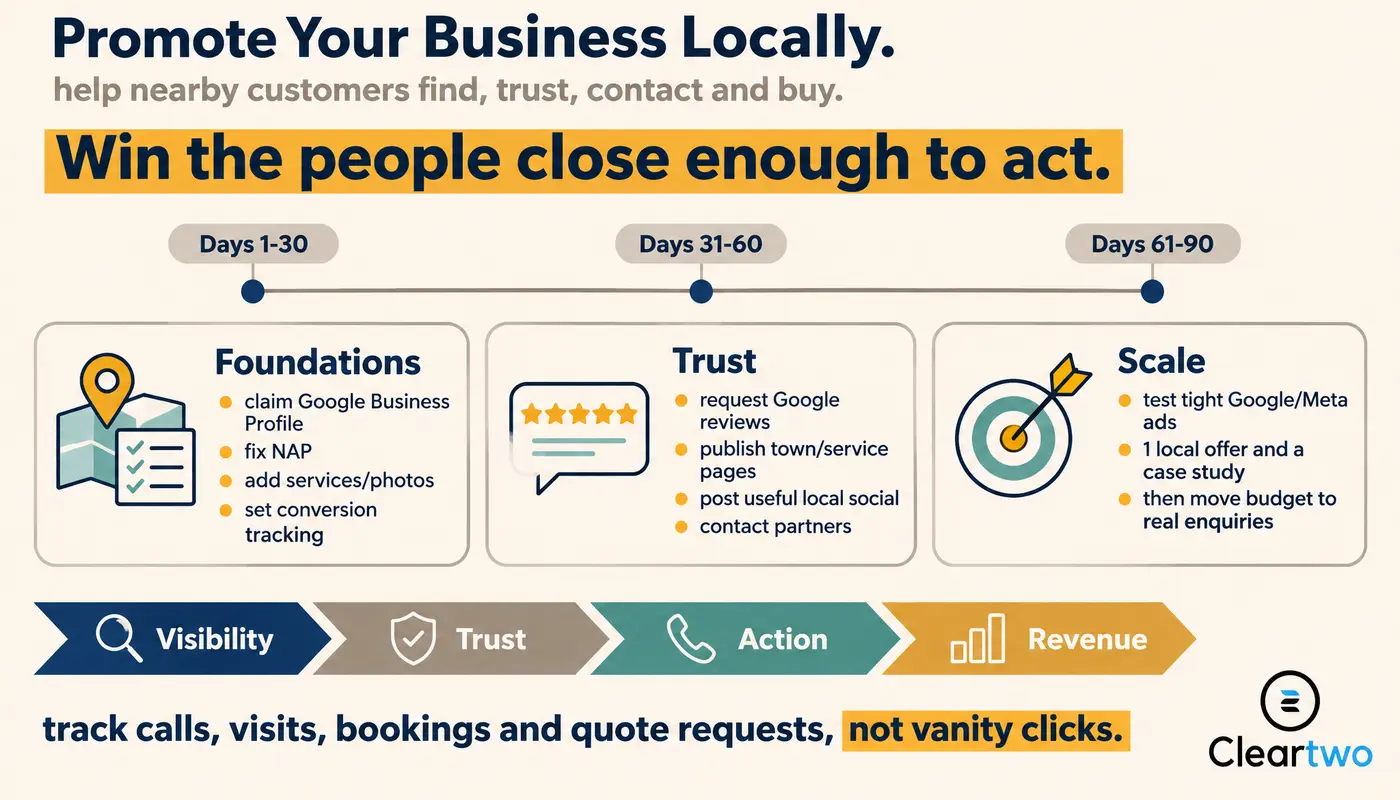
In days 1 to 30, fix the foundations. Claim your Google Business Profile. Correct your details. Add services. Upload photos. Check your website contact information. Set up conversion tracking.
In days 31 to 60, build trust and local relevance. Start asking for reviews. Publish town focused content. Post useful social updates. Contact nearby partners. Add clear calls to action across your website.
In days 61 to 90, scale what works. Run small Google and Meta campaigns. Test one local offer. Publish a local case study. Review your data. Move budget towards channels that bring real enquiries.
Cut the nonsense and keep the plan simple. Local promotion is not about doing everything. It is about doing the right things, measuring them, and improving every month.
Final Thoughts
Local business promotion works when it is clear, useful and measured. Fix your local search presence. Build trust with reviews. Create pages that match real town and service searches. Use social media to stay visible. Track what leads to money, not vanity numbers.
If you want that handled with less guesswork, Cleartwo can help connect local SEO, paid ads, social media, reporting and website performance into one joined up plan.
Frequently Asked Questions
What Is The Fastest Way To Promote A Local Business?
The fastest route is usually Google Business Profile optimisation, local SEO basics, recent reviews and targeted ads. These reach people who are already nearby or actively searching.
Do I Need To Add Near Me Keywords To My Website?
No. Use natural service and town phrases instead. Make sure your location, service area, profile and website are clear.
How Many Google Reviews Does A Local Business Need?
There is no magic number. Aim for genuine, recent and steady reviews that reflect real customer experiences.
Is Social Media Better Than Google For Local Promotion?
Google is better for capturing existing demand. Social media is better for awareness, community and repeat visibility. Use both if your customers use both.
Should Small Businesses Still Use Flyers And Local Press?
Yes, when the area is targeted and the message is clear. Add QR codes, offer codes, or dedicated landing pages so you can measure the response.