
Business Phone Line Providers UK
Choosing the right Business Phone Line Providers UK means checking reliability, VoIP readiness, support, contract terms, number porting, call features, Teams integration, and room to grow. The best provider keeps your customers connected, your team productive, and your costs clear.
Let's be honest, business phones are no longer boring. They now support customer service, sales calls, remote working, CRM data, compliance, and business continuity. That is a massive glow up.
The UK PSTN switch off is planned for January 2027. PSTN means the old public phone network. Analogue and ISDN lines are on borrowed time. If your business still uses old lines, alarms, lift phones, card machines, intercoms, or older PBX kit, now is the time to check everything properly.
Cleartwo helps UK businesses move to modern calling without the stress. As a fully managed UK VoIP specialist, Cleartwo supports managed setup, UK based support, Microsoft Teams voice integration, enterprise features at SME pricing, and a 99.99% uptime SLA.
Why The Right Provider Matters
Your phone provider affects more than calls. It shapes how fast customers reach you, how well staff manage enquiries, how sales teams log conversations, and how your business stays online when problems happen. Missed calls can mean missed revenue.
A good provider gives you a clear move from traditional lines to hosted VoIP, cloud PBX, SIP trunking, or Microsoft Teams Phone. A poor provider gives vague prices, weak support, slow setup, and too many delays when calls fail. That is not the vibe when your main number matters.
Start With What Your Business Needs
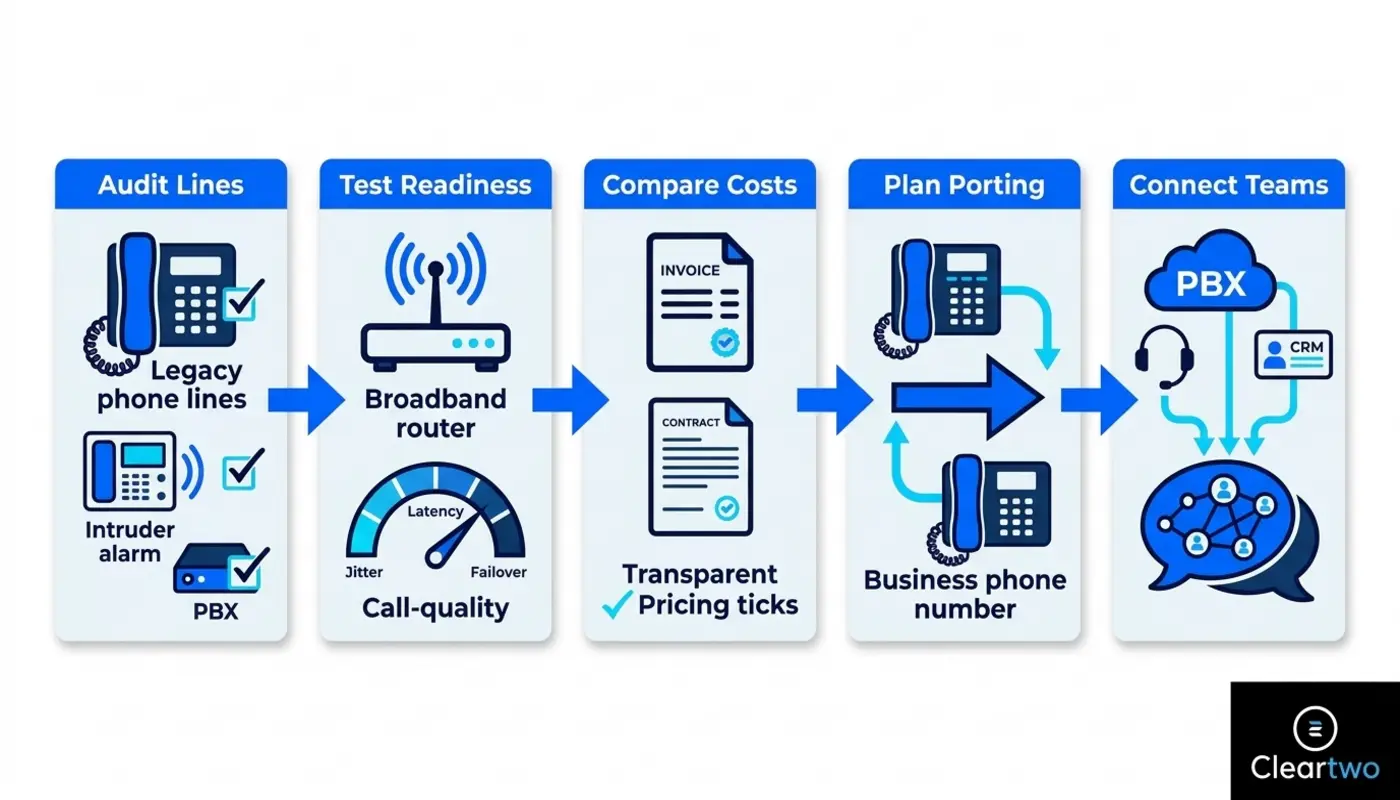
Before you compare providers, get clear on your current setup. Count your users, sites, departments, numbers, devices, and key call routes. Include desk phones, softphones, mobiles, remote workers, reception teams, sales lines, support queues, and shared numbers.
Then check what still depends on traditional phone lines. This may include alarms, payment terminals, fax style services, lift phones, door entry systems, broadband connections, and older PBX hardware. No cap, this is where many UK businesses get caught out.
You also need to define how calls should flow. Do you need an auto attendant, call queues, hunt groups, voicemail to email, time of day routing, overflow routing, call recording, or CRM integration? If yes, write it down before any sales call. It helps you avoid paying for extras you do not need.
Quick Needs Checklist
- Current phone numbers
- Users and teams
- Sites and locations
- Call routing rules
- Call recording needs
- Microsoft Teams voice needs
- CRM integration goals
- Remote working access
- Devices and handsets
- Alarms, lifts, doors, and payment terminals
VoIP Versus Traditional Phone Lines
Traditional analogue and ISDN lines are fixed, old, and less flexible. They were built for a world where staff sat at desks and customers called one main number. Modern work needs more than that.
Hosted VoIP sends calls over an internet connection. A cloud PBX is the phone system that runs online, instead of sitting as a physical box in your office. Users can make and receive calls through desk phones, laptop apps, mobile apps, or Microsoft Teams Phone.
SIP trunking is different. It connects an existing compatible phone system to the wider phone network using the internet. It can work well if your business wants to move in stages or already has an internet ready phone system.
If you want a deeper comparison, Cleartwo has a practical guide on how to choose a business VoIP system. It is useful if you are comparing hosted PBX, SIP trunking, UCaaS, and cloud phone system options. UCaaS means calls, messaging, meetings, and teamwork tools in one connected setup.
Call Quality And Network Reliability
Call quality is not magic. It depends on your broadband, local network, wireless coverage, firewall settings, handsets, apps, and provider setup. If one part is weak, calls can suffer from delay, dropouts, echo, or broken audio.
Ask every provider how they manage jitter, latency, packet loss, monitoring, failover routing, and incident updates. In simple terms, jitter means choppy sound. Latency means delay. Packet loss means missing bits of audio. You need to know how they keep calls clear and what happens if your main connection fails.
A serious provider should offer network readiness checks before migration. This means testing whether your internet and internal network can handle business calls properly. Honestly, skipping this step gives risky energy if your team relies on calls every day.

Pricing And Contract Terms
Do not compare only the headline monthly price. Cheap can become expensive when setup, number rental, call bundles, handsets, call recording storage, porting, training, Teams licences, support, and exit costs are added later.
Ask for the full cost picture. This means setup costs, monthly service, usage, hardware, support, and cancellation terms. Some UK businesses can save a lot by moving to cloud telephony. Market data often suggests possible savings of up to 60%, but your real saving depends on your current setup and call use.
Check contract length, renewal terms, minimum user numbers, licence flexibility, price rise clauses, support inclusions, and what happens to your numbers and recordings if you leave. If a provider cannot explain this clearly, that is a red flag. You deserve clarity before you sign.
Microsoft Teams Phone And CRM Integration
If your business already uses Microsoft 365, Teams voice can be game changing. It lets users make and receive external calls through Teams when the right phone system, routing, and licences are in place. Simple as that.
There are different ways to connect Teams to the phone network. These include Microsoft managed calling, operator based models, and Direct Routing. Direct Routing means connecting Teams to a phone provider through a managed route. This is useful when a business needs more flexibility, complex call routing, current carrier options, or older system links.
CRM integration matters too. Sales and support teams can use click to dial, caller screen pops, automatic call logging, call notes, and recording links inside a cloud CRM or custom CRM system. That is where VoIP moves from phone system to business workflow. Check this out, your team spends less time typing notes and more time helping customers.
This also connects with wider digital operations. Businesses using IT support for businesses, IT security for SMEs, web development services, e-commerce marketing, digital marketing solutions, AI marketing tools, and AI driven solutions should see telephony as part of the same connected stack.
Why CallSwitch One Through Cleartwo Works Well
Cleartwo recommends CallSwitch One for many UK businesses that want a strong hosted VoIP and cloud PBX platform with expert help around it. You can learn more about CallSwitch One if you want to see the platform Cleartwo supports and resells.
Here is the key bit. Cleartwo is a CallSwitch One reseller. This means customers get the benefits of a proven platform plus hands on support from a UK managed service team. That can mean better support, fair pricing, clear responsibility, and less confusion compared with setting everything up alone.
It is not only about buying software. It is about having someone manage discovery, setup, number porting, user training, call routing, Teams voice integration, CRM integration, and ongoing support. That is the vibe many SMEs need, because changing phone systems can feel stressful when customers depend on you being reachable.
Number Porting And Migration Support
Number porting means moving your existing business phone numbers from one provider to another. It sounds simple, but it needs careful checks, timing, testing, and backup planning. Your main sales number should never be rushed.
A good provider should confirm which numbers can be ported, what details are needed, how long it may take, and what happens if a port fails or is delayed. They should also make sure your old service is not cancelled too early.
Cleartwo handles number porting as part of a managed setup process. This includes checking your current numbers, mapping call routes, setting up the new hosted business phone system, testing inbound and outbound calls, and supporting users through the changeover. For deeper planning, this PSTN switch off migration checklist is a smart read.
Support Response Times And Managed Service Value
Support is where providers really separate themselves. Anyone can promise clear calls during a sales chat. The real test is what happens when your reception line stops ringing, a remote worker cannot connect, or a call queue routes to the wrong place.
Ask whether support is UK based, what hours are covered, how urgent faults are ranked, and whether technical support is included. Also ask if there is proactive monitoring, a named account contact, onboarding support, and help with setup changes.
There is a big difference between basic support and a managed service. Basic support reacts when something breaks. A managed service helps design, monitor, improve, and support your system over time. This is why many SMEs prefer Cleartwo's managed VoIP model, especially when they do not have in house telecoms skills.
Final Decision Framework
Here we go. Use a simple scorecard. Rate each provider on reliability, migration support, feature fit, pricing clarity, contract flexibility, Teams Phone capability, CRM integration, security, call recording, scalability, and support response. Give extra weight to reliability, number porting, and who owns the issue when something needs fixing.
Then ask for a like for like proposal. It should show one off costs, monthly costs, assumptions, exclusions, setup plan, porting plan, support terms, and exit terms. If one quote looks cheaper, check what is missing. You may not be getting proper setup, training, or support.
If your setup is complex, run a small pilot. Test real users, real devices, call queues, voicemail, mobile apps, Teams calling, call recording, CRM workflows, and failover. You will learn more from one honest pilot than from ten sales decks.
If you want a provider that understands business telephony UK, cloud PBX, hosted VoIP, SIP trunking, PSTN switch off planning, Microsoft Teams Phone, UCaaS, call recording, and CRM integration, Cleartwo's VoIP phone system services are built around that full picture. Speak with Cleartwo to review your current setup, spot PSTN switch off risks, and plan a cleaner move to modern business calling. Let's go.
Frequently Asked Questions
Do UK Businesses Need To Move Away From PSTN And ISDN Lines?
Yes. Businesses using PSTN or ISDN dependent services should plan a move to digital alternatives before the January 2027 switch off. This is not only about phone handsets. Check alarms, lifts, payment terminals, intercoms, fax style services, broadband dependencies, and older PBX hardware.
Can I Keep My Existing Business Phone Number When Switching Provider?
In most cases, yes. You can keep your existing business number through number porting. The provider will need accurate account details, number records, and a planned cutover date. Always ask about lead times, failed port steps, temporary routing, and when your old service should be cancelled.
Is VoIP Cheaper Than Traditional Business Phone Lines?
VoIP can be cheaper, especially when it reduces line rental, hardware care, call costs, and admin time. The real answer depends on your users, sites, call volumes, handsets, integrations, recording storage, and contract terms. Compare total cost, not just the monthly licence price.
Can Microsoft Teams Work As My Business Phone System?
Yes. Microsoft Teams can support external calling when it is connected to the phone network through the right setup. It works well for many Microsoft 365 users, but call routing, recording, compliance, CRM workflows, and support ownership still need careful planning.
How Long Does It Take To Set Up A Business VoIP System?
A simple VoIP setup can take days. Larger moves with number porting, several sites, Teams Phone, call recording, and CRM integration can take several weeks. The best providers start with discovery, network checks, setup, testing, training, and a controlled changeover plan.