What Is a VoIP Caller?
What Is a VoIP Caller? It is someone who makes or receives a phone call using Voice over Internet Protocol. In simple terms, the voice travels over the internet as digital data, rather than only using an old analogue landline or ISDN line.
If you have seen an unknown number and wondered why it says VoIP caller, do not worry. It is more common than many people realise. Cleartwo helps UK businesses make internet calling simple, trusted and professional. This includes managed setup, UK based support, Microsoft Teams voice integration and a 99.99 per cent uptime service level agreement.
Here's the thing. A VoIP caller is not automatically suspicious. It could be a customer service team, a remote worker, a receptionist, a school office, a GP practice, or a sales adviser. Yes, it can also be a nuisance caller. VoIP is the technology. It does not tell you whether the person calling is genuine.
How Does A VoIP Caller Make A Call?
A VoIP caller speaks into a phone, laptop, mobile app or Microsoft Teams phone setup. The voice is changed into small pieces of digital data. These pieces move through a VoIP platform or hosted business phone system until they reach the person receiving the call.
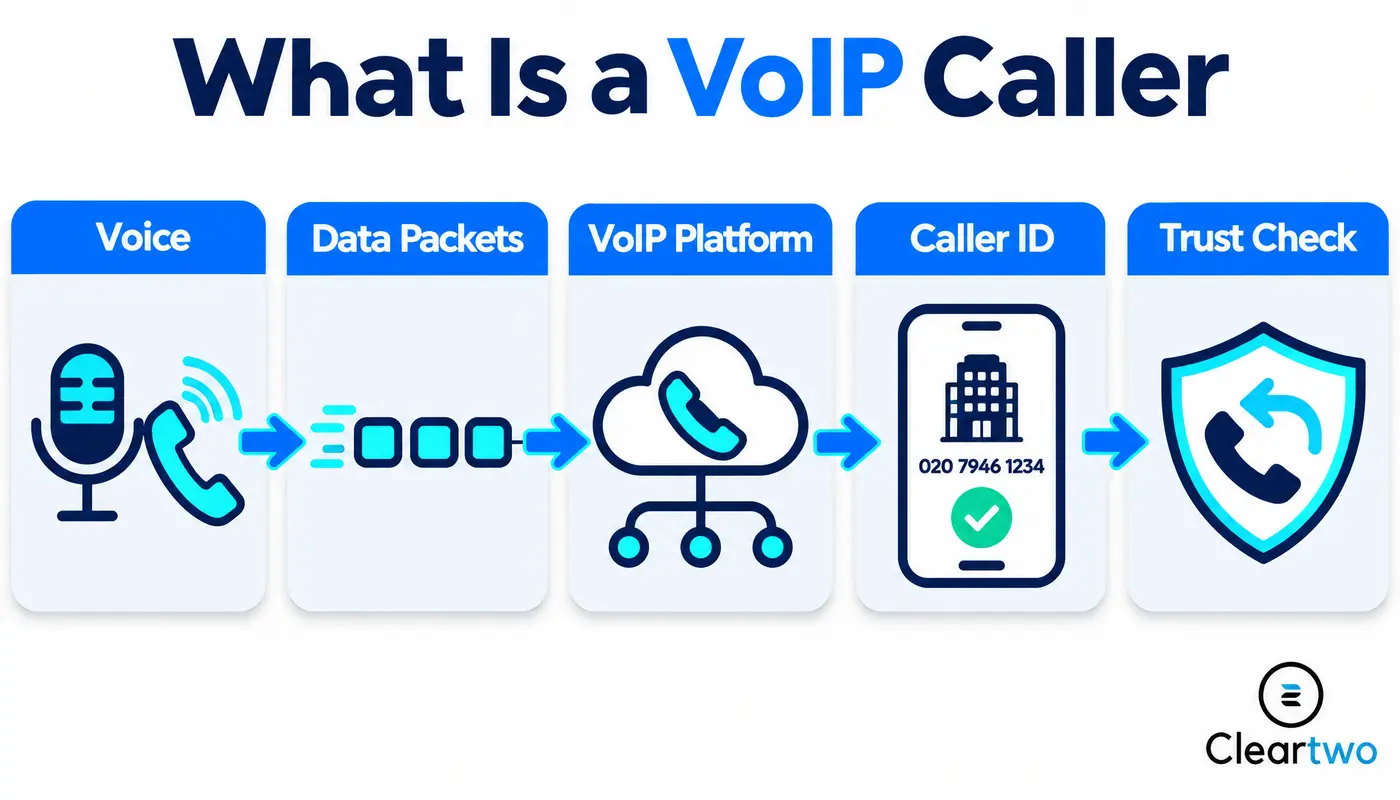
Let's make this simple. Your voice is captured by a device. It is changed into data. It travels across the internet. Then it is rebuilt as sound at the other end. The phone system handles all the tricky parts. You just talk.
Behind the scenes, SIP is often used. SIP stands for Session Initiation Protocol. No need to frame that on the wall. It simply helps start, manage and end the call. If the call needs to reach a normal mobile or landline, it may pass through a gateway that connects VoIP to the wider phone network.
This is why VoIP works so well for business telephony in the UK. A member of staff can call from the office, home, a mobile app or Microsoft Teams, while still showing the company number. That is useful for remote teams, hybrid staff and anyone trying to answer a work call while making tea. No judgment.
What Does VoIP Caller ID Show In The UK?
VoIP caller ID usually shows a phone number, a business name, Unknown, Anonymous or a main switchboard number. What you see depends on how the caller's VoIP system is set up and what your phone network can display.
Two useful terms are calling line ID and calling party name. Calling line ID is the number shown on your screen. Calling party name is the name linked to that caller, where it is supported. In real life, many UK users see the number first and the name only sometimes. Phones are clever, but they are not mind readers. Yet.
A professional business may choose to show one known number for everyone. For example, sales, support and accounts can all call out using the published main number. This helps customers know who is calling. It also makes missed calls easier to return.
The important bit is this. Caller ID helps, but it is not proof of identity. Numbers can be withheld, set up badly or spoofed. Number spoofing means someone makes a false number appear on your screen. Ofcom advises UK users not to rely on the displayed number alone, especially if the caller asks for passwords, payment details or security codes.
Why VoIP Callers Are Becoming More Common In The UK
VoIP callers are becoming more common because the UK is moving away from old analogue and ISDN phone lines. The PSTN switch off means Openreach PSTN users need to move to digital services by 31 January 2027.
PSTN stands for Public Switched Telephone Network. It is the old phone network used by many landlines. ISDN is another older phone line service used by many businesses. Both are being replaced by newer digital calling services.
GOV.UK guidance tells businesses to check more than just phones. Analogue lines may also support alarms, payment terminals, lifts, intercoms, fax machines and other older equipment. Between you and me, this is where many businesses get caught out. They remember the phones, then forget the lift alarm. Awkward.
The UK VoIP market is also growing because more small and medium sized businesses want flexible calling. Many are moving to cloud business telephony, hosted VoIP and UCaaS. UCaaS means unified communications as a service. In plain English, it brings calls, messages, meetings and team tools into one managed system.
If your business is planning a move, Cleartwo VoIP phone systems can help with number porting, call routing, Teams voice integration and call recording before the deadline becomes a panic moment.
Legitimate Uses Of VoIP Calling For UK Businesses
Legitimate VoIP calling is used every day by UK businesses, remote teams and individuals. It supports main business numbers, call queues, auto attendants, voicemail, CRM integration, call recording and flexible working.
A small business can use VoIP to answer calls from different locations without giving staff personal mobiles. A sales team can use CRM integration for click to dial and automatic call logging. CRM means customer relationship management. It is a system that keeps customer details, notes and activity in one place.
A support team can use call queues so customers reach the right person faster. That is much better than bouncing around departments like a pinball. A receptionist can also manage calls from a desk phone, browser or mobile app.
VoIP also links neatly with wider digital tools. Many businesses want their phone system to work with customer records, marketing activity, websites and IT support. It should not sit in a lonely corner doing its own thing. Cleartwo helps clients bring these pieces together so calls feel part of one smooth customer journey.
For Microsoft 365 users, VoIP inside Teams is a strong choice. Staff can make and receive calls from the same place they chat and meet. The Microsoft Teams phone system guide explains how Teams calling can work for UK small and medium sized businesses.
VoIP Callers And Spam In The UK
Scam and nuisance callers often use VoIP because it is low cost, flexible and easy to use at high volume. That does not mean VoIP is bad. It means bad actors like tools that let them call many people quickly.

Criminals may use automated dialling, changing numbers or spoofed caller ID to look more convincing. They may pretend to be from a bank, delivery company, government office or technical support desk. Let's be honest. If someone rings out of the blue and creates panic, pressure or urgency, slow everything down.
If you have answered a suspicious call before, do not beat yourself up. These callers are trained to sound convincing. They rely on catching people off guard. The safest move is to pause, end the call and check using a trusted source.
There are also nuisance marketing calls. Some are legal when handled properly. Others break privacy and marketing rules. UK organisations making marketing calls must follow PECR and data protection rules. They should identify themselves and display a valid number where required.
If you receive a suspicious VoIP call, do not share passwords, one time codes, card details or remote access. End the call. Then contact the organisation using a number from its official website, app, statement or paperwork. Do not use the number the caller gives you. Sneaky, but necessary.
How To Identify A VoIP Call Safely
You usually cannot tell for certain whether an incoming call is VoIP just by looking at it. The number may look geographic, non geographic, mobile, withheld or linked to a business name.
There are clues, but clues are not proof. You may notice repeated calls from similar numbers. You may hear a slight delay, clipped speech or poor audio. You may also receive the call through a business app, desktop phone app or Teams client, which can suggest VoIP is involved.
Still, many good business VoIP calls sound exactly like normal calls. That is the point. A well managed cloud phone system should feel natural to the person receiving the call. If it sounds like someone is speaking through a biscuit tin from 1998, something needs fixing.
Useful checks include: a known business number, a clear company greeting, a return call that works, no pressure tactics, consistent caller identity, secure call handling and clear call quality.
Call Quality And Reliability From A VoIP Caller
Good VoIP call quality should be clear, stable and easy to understand. If a VoIP caller sounds poor, the issue is often broadband capacity, crowded WiFi, delay, uneven delay, missing voice data, poor hardware or weak call routing.
Delay is often called latency. Uneven delay is called jitter. Missing voice data is called packet loss. Lovely little terms, aren't they? The main thing to know is that a managed VoIP service can watch for these issues and reduce them.
Professional hosted VoIP should include reliable routing, backup options, monitoring and support. If broadband fails, calls can often route to mobiles or another location. For UK businesses, that matters. Missed calls can mean missed sales, missed patients, missed clients and one very unimpressed boss.
If your business struggles with call quality, start with the basics. Check your broadband speed. Use wired connections where possible. Reduce heavy network traffic. Make sure handsets and apps are up to date. For more help, you can read our blog on VoIP call quality.
How Cleartwo Builds Trust With Professional VoIP Calling
Cleartwo helps UK businesses use VoIP in a professional way. This includes caller ID, number display, call routing, call recording, Teams integration, CRM integration and compliance focused setup. The goal is simple. Every call should feel trusted, clear and easy to return.
Cleartwo can set approved outbound numbers for people, departments and call queues. This means customers see numbers they recognise, not random or withheld caller IDs. Cleartwo also helps with number porting, SIP trunking, cloud phone setup, mobile apps and hosted VoIP for remote teams.
When a customer needs a platform with specific calling features, Cleartwo may recommend CallSwitch One as part of a managed setup. The useful bit for you is that Cleartwo handles the planning, support and day to day service. You are not left trying to figure everything out alone.
For companies with wider needs, Cleartwo can also connect VoIP with customer systems, web platforms, AI supported tools and wider IT support. That matters because phones rarely work alone anymore. They sit inside a bigger customer journey.
Choosing A VoIP Calling Solution That Keeps Your Number Trusted
Choose a VoIP calling solution that can manage your existing UK numbers, show a consistent caller ID, support call backs, protect call quality and help you move before the PSTN switch off. Cheap is nice. Trusted is better.
Ask whether the provider can port your numbers, set up Teams phone calling, support CRM integration, enable call recording, provide UK based support and design backup routing if broadband drops. Also ask how recordings are stored, who can access them and how long they are kept.
Cost matters too. Cloud VoIP can reduce costs compared with traditional phone systems. Savings depend on users, licences, devices, call volumes, international calls and support. Look at the full cost, not just the monthly headline price that looks lovely until the extras appear like unwanted party guests.
If you still use older lines, now is the time to check phones, alarms, payment terminals and anything else connected to old infrastructure. You have got this. And if you do not fancy doing it alone, Cleartwo can sort it out with a managed migration plan.
Frequently Asked Questions
What Is A VoIP Caller?
A VoIP caller is someone making or receiving a phone call using Voice over Internet Protocol. Their voice is carried as digital data over an IP network, usually the internet, instead of only using an old analogue or ISDN phone line.
How Do I Know If An Incoming Call Is VoIP?
You usually cannot confirm it from the call alone. Caller ID may show a number, a name, Unknown or Anonymous. It does not reliably reveal the technology behind the call. If the call feels odd or rushed, trust your instincts and check it another way.
Are VoIP Calls Always Scams?
No. VoIP is widely used by genuine UK businesses, remote teams, contact centres and individuals. Scammers also use it because it supports low cost calling and number changes. The technology itself is not the problem. The caller's behaviour matters.
Does The PSTN Switch Off Mean My Business Needs VoIP?
Most UK businesses using analogue or ISDN lines will need to move to a digital alternative before the January 2027 PSTN deadline. VoIP is the most common replacement. Businesses should also check alarms, lifts, payment terminals and other connected devices. Not glamorous, I know, but very important.
Is VoIP Call Recording Legal In The UK?
VoIP call recording can be legal when handled clearly and securely. Businesses should tell people when calls are recorded, explain why, control access and keep recordings only as long as needed. If you work in a regulated sector, it is worth getting specialist compliance advice.