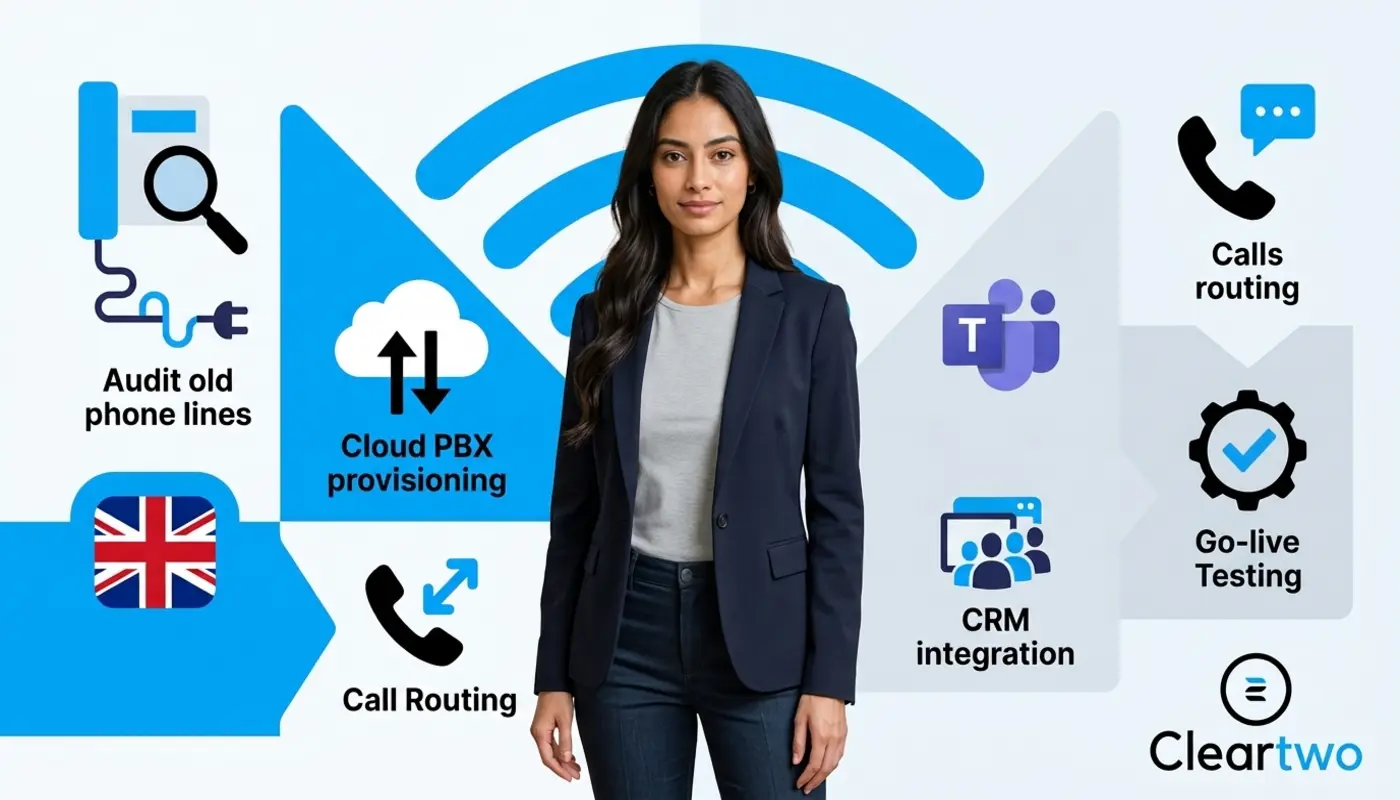


How does VoIP work business? Honestly, it is much simpler than it sounds. Business VoIP takes your voice, turns it into digital data, sends it over the internet, and converts it back into sound at the other end. That is it. No old copper phone lines. No bulky on site PBX boxes. Just smart cloud tech doing its thing.
If you have read our plain English guide to what VoIP is, this is the next step. We go a little deeper. But we keep it simple. No boring telecom talk.
With the ISDN switch off 2027 deadline getting closer, this is not just interesting tech. It is something every UK business needs to understand. At Cleartwo, we help companies move to modern hosted VoIP phone systems with full setup, UK support, and 99.99 percent uptime SLA. No stress. Just a smooth move.
How Does Business VoIP Work In Real Life?
Let us break it down properly.
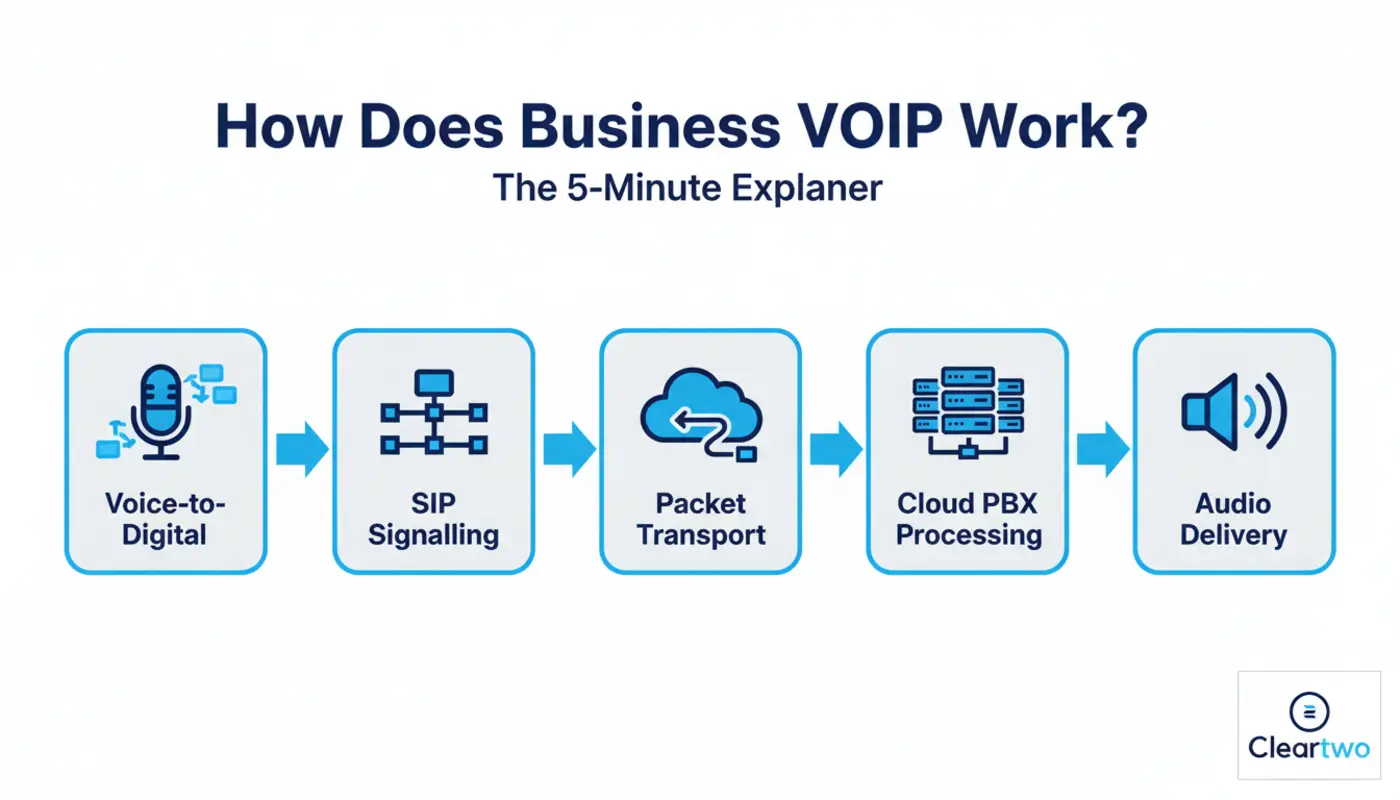
When you speak into a VoIP phone, headset, or softphone app, your voice starts as an analogue sound wave. Just normal audio. The VoIP system converts that sound into digital voice packets. Think of them as tiny bits of data moving across the internet.
These packets travel using IP, which means Internet Protocol. It sounds technical, but it is the same network that powers your email, websites, and cloud apps. Nothing fancy. Just smart routing.
At the other end, the system rebuilds the packets in the right order and turns them back into sound. The other person hears your voice. Simple as that.

The Step By Step Flow Of A Business VoIP Call
Here is how a typical business telephony UK call works.
- You dial a number from your desk phone, mobile app, or Microsoft Teams.
- Your device connects to your cloud PBX provider.
- SIP signalling sets up the call. SIP is the system that tells the network who is calling and where the call should go.
- Your voice is compressed using a codec. A codec is software that reduces the size of audio so it travels faster without losing quality.
- The digital voice packets travel over your broadband or leased line.
- The other person’s device receives the packets and turns them back into audio.
There is no fixed physical line like old PSTN systems. This is packet switching. It is more efficient and more flexible. Why stay stuck in the past?
VoIP Vs Traditional Phone Lines
Let us be honest. Traditional landlines feel outdated.
Old PSTN and ISDN systems use circuit switching. This means a full connection stays open for the whole call, even when no one is speaking. You are paying for silence.
VoIP uses packet switching. Data only moves when needed. That is why it scales better and often costs less.
- Lower call costs
- Cloud based setup
- Ready for remote teams
- Built in call recording
- Easy CRM integration
- Microsoft Teams phone capability
- Future proof solution
With the PSTN switch off UK migration checklist already live, staying on legacy lines is not a long term option. If you are still running ISDN, now is the time to move.
What Is A Cloud PBX And Where Does It Fit?
Years ago, businesses had a PBX box in the office. It routed calls. It was costly and needed regular maintenance. If it failed, everything stopped.
Now the PBX sits in the cloud. That is hosted VoIP.
Your call routing, auto attendants, call queues, voicemail to email, and call recording all run in secure UK data centres. You manage it through a simple web portal. No heavy hardware. No engineer visits.
For a deeper look, read our hosted PBX vs cloud VoIP breakdown. It clears up common confusion.
This is also where UCaaS comes in. Unified Communications as a Service brings voice, video, messaging, and collaboration into one platform. One login. One system. That is the modern comms stack.
How Does VoIP Connect With CRM And Business Systems?
This is where it gets powerful.
Because VoIP runs over IP networks, it connects directly with your cloud CRM and other tools. When a customer calls, their record can pop up instantly. Notes. Orders. Open tickets. All in front of you.
Calls log automatically into your CRM. Recordings attach to contact records for compliance. Sales activity links to call data. That saves your team time every single week.
At Cleartwo, we connect VoIP with CRM platforms and wider CRM integrations. Your communications become part of your wider automation flow. That is real digital progress.
What About Microsoft Teams Phone?
If your team already uses Microsoft 365, this is huge.
VoIP connects to Teams using Direct Routing. This means you can make and receive external calls inside Teams. No separate handset needed. Clean setup. Smooth workflow.
You get business grade calling without expensive calling plans. We explain this in our Microsoft Teams phone system UK guide.
Hybrid team. Remote staff. Multiple offices. One platform for chat, meetings, and voice. That is the vibe.
Is Business VoIP Reliable Enough?
Short answer. Yes, if it is set up properly.
Modern hosted VoIP platforms run in resilient data centres with built in failover. If your broadband drops, calls can reroute to mobiles. Backup systems keep services running.
At Cleartwo, we set up Quality of Service on your network. This simply means voice traffic gets priority. Even if someone is uploading large files, your calls stay clear.
We partner with leading UK UCaaS providers to deliver strong infrastructure. But you deal directly with Cleartwo. UK support. Managed setup. Fair pricing. Enterprise features at SME level. That support makes a real difference.
Why The 2027 Switch Off Changes Everything
The UK PSTN switch off in January 2027 means all analogue and ISDN lines are being retired. Most UK landlines have already moved to digital services.
If you are still using legacy circuits, it is not a maybe. It is a when. Leaving it until 2026 will only add pressure.
VoIP is not just cheaper. It is the replacement network. Everything is moving to IP. Voice included. Let us go.
How Does Business VoIP Work In One Sentence?
Here is the simple version.
Business VoIP converts your voice into digital data, sends it securely over the internet using SIP and codecs, manages it through a cloud PBX, and delivers it as clear audio at the other end.
That is modern business communication. Simple as that.
Why Businesses Choose Cleartwo For Hosted VoIP
We do more than move phone lines.
We manage full migration from ISDN or legacy PBX. Number porting. User training. CRM integration. Call flow design. Ongoing optimisation.
You get a powerful cloud platform backed by solid infrastructure. On top of that, you get Cleartwo’s managed service. Faster fixes. Real support. A team that knows your setup.
No overcomplication. Just modern comms that work. You have got this.
Frequently Asked Questions
What Is SIP In Business VoIP?
SIP stands for Session Initiation Protocol. It is the signalling system that sets up and manages VoIP calls. It tells the network who is calling and when the call starts and ends.
Can I Keep My Business Number When Switching To VoIP?
In most cases, yes. You can port your existing number to a hosted VoIP provider. The transfer is managed during migration and usually takes a few weeks.
Is VoIP Cheaper Than Traditional Landlines?
For many UK SMEs, yes. Savings can reach up to 60 percent compared to ISDN and legacy PBX systems. Lower line rental and no on site hardware reduce costs.
Does VoIP Work With Microsoft Teams?
Yes. With Direct Routing, a VoIP provider can connect your cloud PBX to Microsoft Teams. Users can make and receive external calls inside Teams while keeping full business telephony UK features.
What Internet Speed Do I Need For Business VoIP?
VoIP does not need huge bandwidth. One HD call uses around 100 kbps. What matters most is stable internet and proper Quality of Service so voice traffic stays prioritised.
The move to hosted VoIP and cloud PBX is not just an upgrade. It is how modern business communication works. Let us get your system future ready with Cleartwo.