

What Is VoIP Technology For UK Businesses
What is VoIP technology? VoIP means Voice over Internet Protocol. It lets you make and receive phone calls over the internet instead of using old copper phone lines. For UK businesses, it is now a key move away from the Public Switched Telephone Network, or PSTN, and Integrated Services Digital Network, or ISDN. This matters more as the national switch off gets closer.
Here's the thing. VoIP sounds technical, but it is simply your phone system becoming part of your digital setup. If you already use cloud tools such as Microsoft 365, customer relationship management, known as CRM, or business automation, VoIP can sit neatly beside them. You can explore Cleartwo's wider technology support through Cleartwo digital solutions.
Cleartwo helps UK organisations move to modern VoIP with managed setup, UK based support, Teams voice integration, strong business features at small business pricing, and a 99.99 percent uptime service level agreement, or SLA. No stress. No mystery box. No phone system that needs a secret handshake to work.
How VoIP Technology Works
VoIP technology works by turning your voice into small digital data packets. These packets travel over the internet. They are then rebuilt as sound at the other end. It is a fast and clever process, but the result feels like a normal phone call.
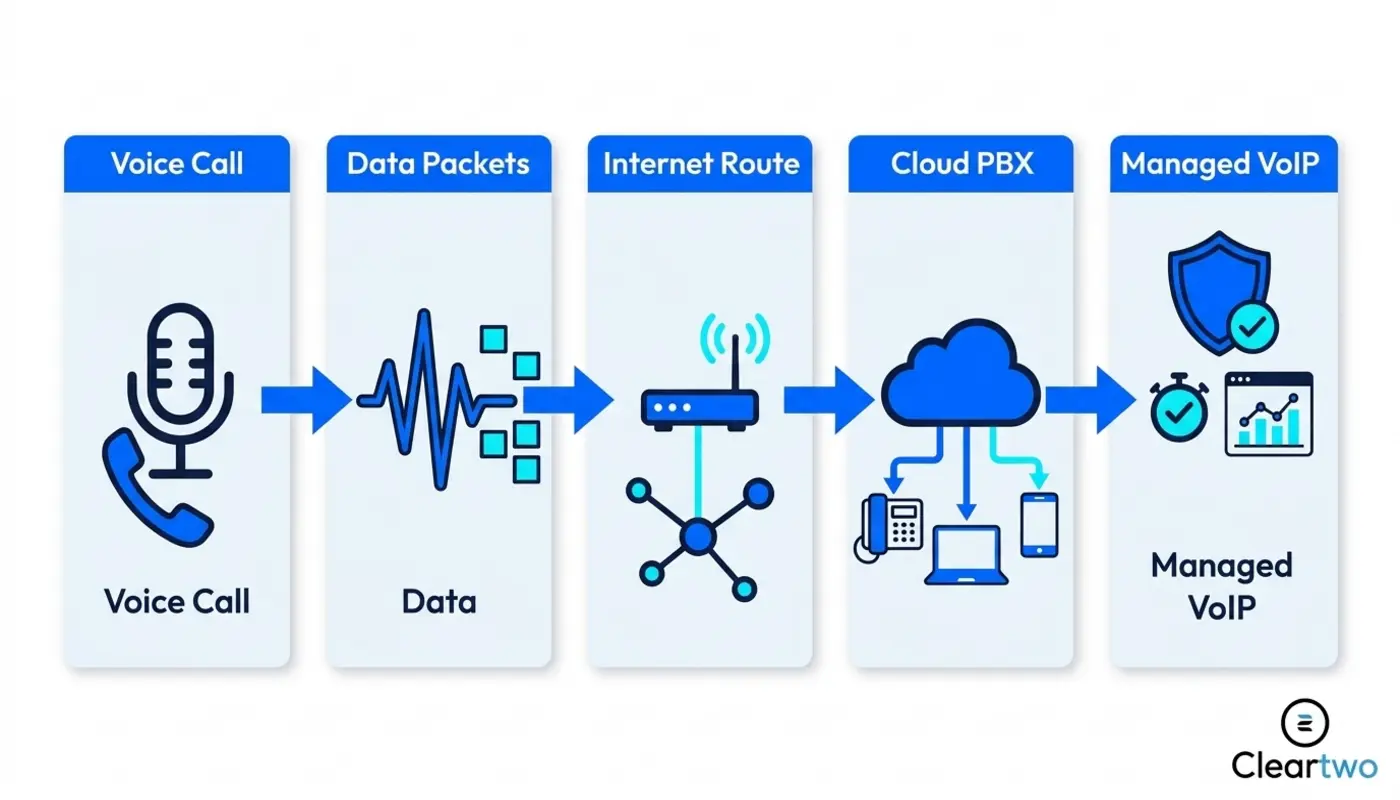
When you speak into a VoIP phone, headset, mobile app, or laptop softphone, your voice starts as sound. The system changes it into digital data using a codec. A codec is a tool that compresses sound so it can move clearly across the internet.
You do not need to remember every technical name. It helps to know that each part has a job. Session Initiation Protocol, or SIP, helps start and manage the call. Real Time Protocol, or RTP, carries the voice during the call. In simple terms, SIP is the organiser and RTP is the delivery driver.
The voice data then travels through your broadband, fibre, leased line, or private network. At the other end, the packets are put back in the right order. The listener hears your voice almost straight away. When the network is set up well, calls sound clear and steady.
Why VoIP Is Replacing Traditional Phone Systems
VoIP is replacing traditional phone systems because the UK is moving away from analogue lines and towards digital networks. Openreach has confirmed that the old PSTN network is due to be retired by 31 January 2027. This means businesses still using analogue lines or ISDN need a clear migration plan.
Traditional PSTN and ISDN systems were built for fixed desks, office switchboards, and physical phone lines. They worked well for many years. But they were not built for hybrid teams, customer data, call reports, Teams phone integration, or CRM integration.
VoIP supports modern business calls in a cleaner way. Calls can be routed to mobiles, desk phones, laptops, home workers, branch offices, or contact centre teams. It can also connect with CRM systems, support platforms, reporting tools, and wider IT support for businesses.
For many small and medium sized businesses, or SMEs, cost is also a big reason to move. Hosted VoIP and cloud PBX systems can reduce line rental. They can also remove old PBX hardware. Calling, voicemail, call recording, reporting, and user management can be handled in one monthly service.
Key Parts Of A Complete VoIP System
A complete VoIP system has several parts working together. The good news is that you do not need to become a telecoms engineer to understand them. Let's make this simple.
The first part is your device. This could be an IP phone on a desk, a headset linked to a laptop, a mobile app, or a browser based softphone. A softphone is phone software that lets you make calls without a physical handset.
The second part is the cloud PBX. PBX means private branch exchange. It is the system that manages calls inside your organisation. In older setups, this was often a box in a cupboard. With hosted PBX, it sits in the cloud and is managed for you.
The third part is connectivity. Your internet connection, router, firewall, switches, and WiFi can all affect call quality. If your network is patchy, your calls may sound patchy too. No judgment. We have all blamed the headset before checking the WiFi.
The fourth part is integration. Modern VoIP can connect with Microsoft Teams phone, CRMs, support desks, e commerce marketing tools, reports, call recording platforms, and unified communications features such as video, messaging, and presence.
- Hosted VoIP calling
- Cloud PBX control
- SIP trunking access
- Teams voice integration
- CRM call logging
- Secure call recording
- Mobile working support
Types Of VoIP Technology Deployments
There are three main VoIP deployment models for UK businesses in 2026. The best choice depends on your current phone system, team size, compliance needs, and how much technical work you want to manage yourself.
A fully hosted cloud phone system is usually the simplest option. Your phone system lives in the cloud. Users connect through phones or apps. Features such as call queues, voicemail, reporting, call recording, and auto attendants are managed online. This is popular with SMEs because it removes old hardware problems.
SIP trunking works in a different way. It lets an existing PBX connect to phone networks using internet based lines instead of ISDN. SIP trunking compared with ISDN is a common question for businesses that want to keep some existing equipment while getting ready for the PSTN switch off.
VoIP can also work inside Microsoft Teams. With Teams Direct Routing UK options, businesses can bring external phone calls into Teams. Staff can call clients, suppliers, and mobiles from the same app they already use for meetings and chat. For more detail, read Cleartwo's Microsoft Teams phone system guide.
VoIP Technology Vs PSTN And ISDN
VoIP technology is more flexible than PSTN and ISDN because it is led by software, ready for the cloud, and not tied to one physical line in one place. PSTN and ISDN use older circuit based networks. This means a dedicated channel is held open for each call.

With VoIP, calls travel as data packets over an IP network. This is more efficient because the network sends data only when it is needed. It also makes features easier to add. Need call queues? Add them. Need voicemail to email? Switch it on. Need reports? Open the dashboard.
Traditional systems often need engineer visits, extra hardware, and separate charges for features. Older setups can also make costs creep up quietly. VoIP gives businesses more control, especially when it is delivered as a managed service with clear pricing.
If you are still weighing up the difference, Cleartwo has a helpful related article on VoIP compared with traditional phone systems. It is useful if your current setup still includes ISDN channels, old handsets, or a PBX that everyone is slightly afraid to restart.
The Role Of Internet And Network Infrastructure
VoIP call quality depends heavily on your internet and local network. The phone system can be excellent, but if the broadband is struggling, calls may suffer. It is a bit like buying a sports car and only driving it through potholes.
Most VoIP calls use a modest amount of bandwidth. Reliability matters more than raw speed. A steady fibre connection is better than a fast connection that drops every ten minutes. Businesses with busy call teams may need Fibre to the Premises, often called FTTP, leased lines, or backup mobile connectivity.
Network tools such as QoS can give voice traffic priority. QoS means quality of service. In plain English, it tells your network that phone calls should go first, ahead of someone downloading a huge file or streaming a product demo.
Good VoIP planning also looks at routers, firewalls, switches, WiFi coverage, separate voice networks, and backup routes. This is where managed VoIP services earn their keep. Cleartwo reviews the full environment, not just the phone licence, so your system works properly in the real world.
Security Reliability And Compliance In VoIP
VoIP security matters because calls are digital data. That means they can be protected well, but they must be set up properly. The main risks include call fraud, weak passwords, exposed devices, poor firewall rules, and unauthorised access to recordings.
A secure VoIP setup should include strong sign in controls, encryption where needed, limited admin access, fraud monitoring, firewall rules, and secure call recording storage. For regulated firms, this is not just tidy IT. It can be important for the General Data Protection Regulation, or GDPR, Financial Conduct Authority expectations, and Markets in Financial Instruments Directive rules, often called MiFID II.
Call recording needs special care. Businesses should know why they record calls, how long they keep them, who can access them, and how recordings are protected. A managed provider can help set retention rules and access controls. That way, sensitive data is not treated like loose paperwork in a drawer.
Reliability is just as important. Cloud VoIP can support failover, mobile routing, backup internet, and disaster recovery. If one site loses connection, calls can be diverted to another office, mobile app, or voicemail service.
Why Cleartwo Often Recommends CallSwitch One
For many UK businesses, Cleartwo often recommends CallSwitch One because it brings hosted VoIP, cloud PBX, call routing, mobile apps, reports, call recording, and integrations into one practical platform. It is strong enough for growing teams, but still manageable for SMEs that do not want telecoms to become a full time hobby.
Cleartwo supplies and supports CallSwitch One as part of a managed VoIP solution. This gives customers a useful advantage. You get a strong VoIP platform through a UK managed partner that understands your setup, users, network, and business goals. You can learn more about the platform at CallSwitch One.
Working with Cleartwo also means practical support, clear pricing, and a smoother service route. You are not left alone with portals, settings, number porting, and Teams voice integration. The tricky bits are handled for you.
How VoIP Is Evolving For UK Businesses In 2026
VoIP has moved far beyond basic internet calling. In 2026, it sits at the centre of UCaaS, which means Unified Communications as a Service. That simply means voice, video, messaging, meetings, and collaboration working together through the cloud.
Modern VoIP is also becoming more connected to customer experience. Sales teams want click to call from CRM records. Support teams want call notes, recordings, transcripts, and missed call alerts. Leaders want reports that show call volume, response time, and team performance.
Smart tools are also appearing in VoIP platforms. These can include call summaries, sentiment checks, transcription, and smart routing. Used sensibly, these tools can save time and improve service. Used badly, they can annoy everyone. Balance matters.
For UK SMEs, the next big step is not only replacing lines before the PSTN switch off deadline. It is using VoIP to create a smarter and more joined up communication system. That system can work with IT security for SMEs, CRM, marketing, support, and everyday operations.
How Cleartwo Delivers VoIP Around Real Business Needs
Cleartwo starts with the business, not the phone catalogue. That means checking your current numbers, lines, users, locations, call flows, internet connections, compliance needs, and future plans before recommending a setup.
For some teams, the answer is a cloud based phone system UK users can access from anywhere. For others, it may be SIP trunking for an existing PBX, or Teams voice integration for staff already working inside Microsoft 365. Cleartwo can also support CRM integration, reporting, call recording, and wider IT support.
The managed approach matters. Number porting, handset setup, call routing, training, network checks, and security rules all need attention. Cleartwo handles the setup and support, so your team can focus on serving customers, not decoding telecoms settings at 4.55 on a Friday.
FAQs About VoIP Technology For UK Businesses
Is VoIP Reliable Enough To Replace PSTN Or ISDN?
Yes. VoIP is reliable enough for most UK businesses when it is set up correctly. The key is stable internet, good network setup, backup options, and a managed provider that monitors the service. With proper planning, VoIP can be more resilient than older phone systems.
Can We Keep Our Existing Phone Numbers When Moving To VoIP?
In most cases, yes. Business phone numbers can usually be ported to a VoIP provider. This means clients and suppliers can still reach you on the same numbers. The process should be planned carefully to avoid downtime, especially if you have several sites or older ISDN services.
How Does VoIP Work With Microsoft Teams And CRM?
VoIP can connect with Microsoft Teams through Teams phone and Direct Routing style setups. This lets users make external calls inside Teams. CRM integration can add click to call, automatic call logging, contact screen pops, recordings, and notes. This helps sales and support teams work faster.
Is VoIP Call Recording Compliant With GDPR?
VoIP call recording can support GDPR compliance when it is set up with clear policies, secure storage, access controls, retention rules, and a lawful reason for recording. Businesses should tell callers when calls are recorded. Only authorised people should be able to access recordings.
How Long Does A VoIP Migration Usually Take?
A simple VoIP migration can take a few weeks. Larger or multi site projects may take longer. The timeline depends on number porting, network readiness, handset setup, integrations, training, and testing. Starting early is wise, especially before the 31 January 2027 PSTN switch off.