

VoIP Call Basics
A VoIP call is a phone call made over the internet instead of old copper phone lines. Your voice is turned into digital data, sent through broadband, then rebuilt as sound at the other end. That is why modern VoIP phone systems for UK businesses can work across desk phones, mobiles, laptops and Microsoft Teams.
Let’s be real. The phone still feels like a phone. You dial, someone answers, and you talk. The clever bit is that the call is no longer tied to a wall socket from the 1980s.
Short version. VoIP gives your business internet calling, flexible devices, lower costs, better routing, and a cleaner move away from old phone lines. Cleartwo helps UK businesses make this move without the usual telecoms drama. As a fully managed UK VoIP specialist, Cleartwo handles setup, Teams voice integration, UK based support, and enterprise features at SME pricing. It also provides a 99.99% uptime service level agreement.
How A VoIP Call Works
When you make a VoIP call, your device records your voice, turns it into small data packets, sends those packets across the internet, then puts them back together for the person listening. That is the simple version. Honestly, it is enough for most people unless they enjoy reading router manuals for fun.
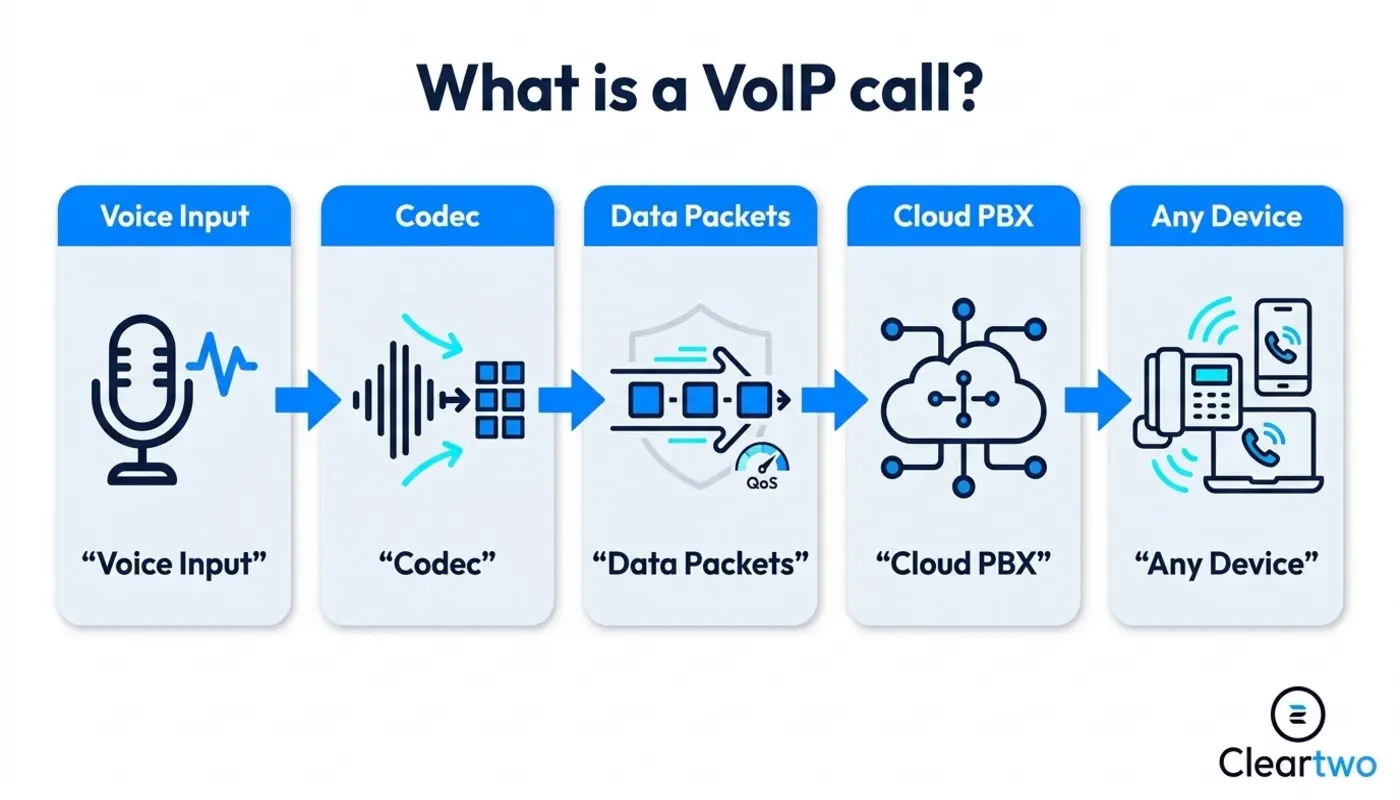 Here’s what is actually happening. Your voice is encoded using a codec. A codec is software that compresses audio so it can travel quickly. The call is set up using SIP. SIP is the method that starts and ends the call. The audio usually travels using RTP, which carries your voice during the call.
Traditional landlines use circuit switched calling. That means one fixed path is held open for the whole call. VoIP uses packet switched voice communication. Your voice travels as data packets across IP networks. It is more flexible, easier to scale, and much better suited to modern business telephony in the UK.
VoIP Calls Vs Landline And Mobile Calls
VoIP calls are different from landline and mobile calls because they use internet calling instead of a fixed analogue line or a mobile voice network. Your business number can follow you across devices, rather than sitting on a desk phone in an empty office. Come on, we can do better than that now.
With a landline, your number is normally tied to one place. With mobile calls, your number sits on a SIM. With hosted VoIP, your number lives in the cloud PBX. A cloud PBX is an online phone system that manages users, call routing, voicemail, and call features.
So what does this mean when your team works from home? It means calls can ring on a desk phone, softphone app, mobile, or Teams client. Staff do not need to use personal mobiles for client calls. If you want a deeper remote working view, read Cleartwo’s guide to VoIP for remote teams.
Why The UK PSTN Switch Off Matters
The UK PSTN switch off means old analogue and ISDN phone services are being retired. Businesses are expected to move to digital voice before the January 2027 deadline. So no, this is not one of those upgrades people should leave until the last week and then act surprised.
Over two thirds of UK landlines have already moved towards VoIP. The market is growing fast too. The UK VoIP market is forecast to grow by £5.3 billion between 2025 and 2029. That is not a fad. That is the country changing how calls work.
If your business still relies on ISDN, legacy PBX hardware, or old analogue lines, you need a plan. Cleartwo’s PSTN switch off migration checklist explains what to check before you move.
What UK Businesses Need For VoIP Calls
To make and receive VoIP calls, a UK business needs reliable broadband, VoIP ready devices, a hosted VoIP service, correct network settings, and a business number. That sounds like a lot, but it is not rocket science unless someone makes it so. Telecoms providers have been oddly good at doing that for years.
Your setup can include IP desk phones, mobile apps, laptop softphones, headsets, or Microsoft Teams phone integration. Older handsets can sometimes work through an adapter. Bluntly, keeping ancient hardware alive is not always the smart move.
Your broadband matters. Voice does not need huge bandwidth, but it does need stability. Latency, jitter, and packet loss are the villains here. Latency means delay. Jitter means uneven delay. Packet loss means small parts of the audio go missing. Worried your calls will drop every five minutes? Fix the network first, then judge the phone system.
- Reliable business broadband
- VoIP ready router
- VoIP desk phones
- Softphone mobile apps
- Microsoft Teams calling
- Secure firewall rules
- Backup connection plan
Businesses already using Microsoft 365 can often bring calls into Teams through managed voice integration. Cleartwo covers this in its Microsoft Teams phone system guide.
VoIP Call Quality And What Affects It
VoIP call quality depends on broadband stability, router setup, network traffic, device quality, and how well voice data is prioritised. Cut the nonsense. If your office network is held together by a bargain router and hope, your calls will suffer.
 The three main quality issues are latency, jitter, and packet loss. Latency is delay. Jitter is uneven delay. Packet loss means parts of the audio do not arrive. All three make conversations awkward.
Good VoIP uses Quality of Service, often called QoS, to prioritise voice traffic above less urgent data. In plain English, it tells your network that calls matter more than someone uploading a huge file or streaming another training video nobody asked for.
Managed setup helps too. Cleartwo can review your network, routers, firewalls, and broadband before migration. For more detail, see how to improve VoIP call quality.
VoIP Calls Across Different Devices
VoIP calls work across different devices because your number is linked to a cloud PBX rather than one physical line. One business number can ring on your desk phone, laptop, mobile app, and Teams client, depending on your rules.
This is useful for remote staff, office teams, salespeople, and field workers. A recruiter can call from a laptop. A support agent can answer from a headset. A director can take a client call on mobile without giving out a personal number. Revolutionary, I know.
VoIP also supports call routing, hunt groups, call queues, and voicemail to email. These are not fancy extras. They are basic business call handling features that stop customers being bounced around or sent nowhere useful.
The Cost Of VoIP Calls
VoIP calls usually cost less than traditional phone calls because businesses reduce line rental, avoid expensive PBX hardware, and use bundled minutes or lower call rates. For many UK SMEs, cloud VoIP can cut phone costs by up to 60% compared with old systems.
The real saving is not just the call rate. It is removing separate lines, maintenance contracts, and hardware upgrades. A 20 user business can often save hundreds per month once everything is moved into a hosted VoIP phone system.
Internal calls between users on the same platform are often included. Calls to UK landlines, mobiles, and international numbers depend on your package. If you want the pricing side without sales waffle, read Cleartwo’s UK business VoIP cost guide.
Security And Privacy For VoIP Calls
VoIP calls are safe when the system is set up properly with encryption, strong passwords, firewall controls, and secure call routing. Stop pretending any phone system is secure by default. Old landlines had risks too. They just looked less digital and therefore less scary.
Common VoIP risks include eavesdropping, spoofed calls, weak user passwords, and denial of service attacks. A secure setup uses encrypted call signalling and media where available, session border controllers, controlled admin access, and regular monitoring. A session border controller is basically a security gate for voice traffic.
Call recording also needs care. UK businesses must think about GDPR, retention rules, consent, access permissions, and sector duties such as financial services compliance.
VoIP Call Integration With Business Tools
VoIP calls can connect with wider business tools such as Microsoft Teams, cloud CRM platforms, analytics dashboards, call recording systems, and helpdesk software. This is where VoIP stops being just a phone replacement and starts doing useful work.
Sales teams can use CRM integration for click to call, screen pop details, automatic call logging, and call notes. That means fewer missed follow ups and less manual admin. If your team still copies phone notes into spreadsheets, come on, we can do better.
VoIP can also connect call data with customer records, support tickets, and reports. That matters because a call is not just a chat. It can be a sales lead, a service issue, a complaint, a booking, or a customer who is about to leave if nobody answers properly.
Cleartwo also offers wider digital support, from CRM integrations to IT support for SMEs, so your phone system does not sit in a lonely silo doing one job badly.
Why Managed VoIP Is Worth It
A managed VoIP platform is worth considering if your business wants hosted calling, cloud PBX features, mobile apps, call recording, analytics, and Microsoft Teams phone capability without turning the project into a full time job.
Buying powerful VoIP software is one thing. Setting it up properly is another. Cleartwo can help plan, configure, migrate, and support the service, instead of leaving you alone with a login and a support portal.
This approach is useful for SMEs that want enterprise features without enterprise nonsense. You get SIP trunking options, call routing, CRM integration, UCaaS tools, and practical UK support from Cleartwo. UCaaS means unified communications as a service. In normal English, it means calls, messaging, meetings, and related tools are managed through the cloud.
Common Questions Before Switching
UK businesses usually ask whether VoIP call quality will match landlines, whether they can keep numbers, how long setup takes, and what happens if broadband fails. These are sensible questions. Not asking them is how you end up with a phone system nobody likes and everyone blames on IT.
Your business numbers can normally be ported to VoIP. Setup time depends on users, sites, integrations, and number porting. A small team can be live quickly. Multi site moves need more planning..
Backup matters too. You can use mobile failover, 4G or 5G backup, call forwarding, and dual broadband circuits. VoIP does rely on power and internet, so resilience planning is not optional. It is the boring bit that saves your neck later.
Frequently Asked Questions
Do I Need To Change My Existing Phone Numbers To Use VoIP?
No, most UK business phone numbers can be moved to VoIP through number porting. This transfers your existing numbers from the old provider to the new VoIP service. Customers can still call the same number, and your team can avoid changing stationery, websites, and email signatures.
How Much Bandwidth Do I Need Per VoIP Call?
A typical VoIP call needs around 100 kbps per call for both upload and download. Quality depends more on stability than raw speed. For business use, allow extra capacity, prioritise voice traffic with QoS, and avoid running calls over weak Wi Fi or overloaded broadband.
Can VoIP Calls Work Reliably Over Wi Fi?
Yes, VoIP can work over Wi Fi if the signal is strong, the network is set up well, and voice traffic is not competing with heavy downloads. For office teams, wired connections are still more reliable for desk phones. Wi Fi suits mobiles, laptops, and flexible work areas.
What Happens If My Broadband Or Power Goes Down?
If broadband or power fails, VoIP calls can be redirected to mobiles, another site, or a backup connection such as 4G or 5G. A good VoIP setup should include failover planning. Relying on one connection and hoping for the best is not a business continuity strategy.
What Is The Difference Between Hosted VoIP, SIP Trunking And Cloud PBX?
Hosted VoIP runs your phone system in the cloud and suits most SMEs. SIP trunking connects an existing IP PBX to the phone network. A cloud PBX is the cloud based call control system that manages routing, voicemail, queues, users, and business phone features.